- Why do Yohji Yamamoto's clothes work despite being "oversized"?
- From haute couture to ready-to-wear
- Things introduced by Japanese designers in the 1980s
- Why don't you emphasize your body?
- Fashion as discussed in "Making Clothes"
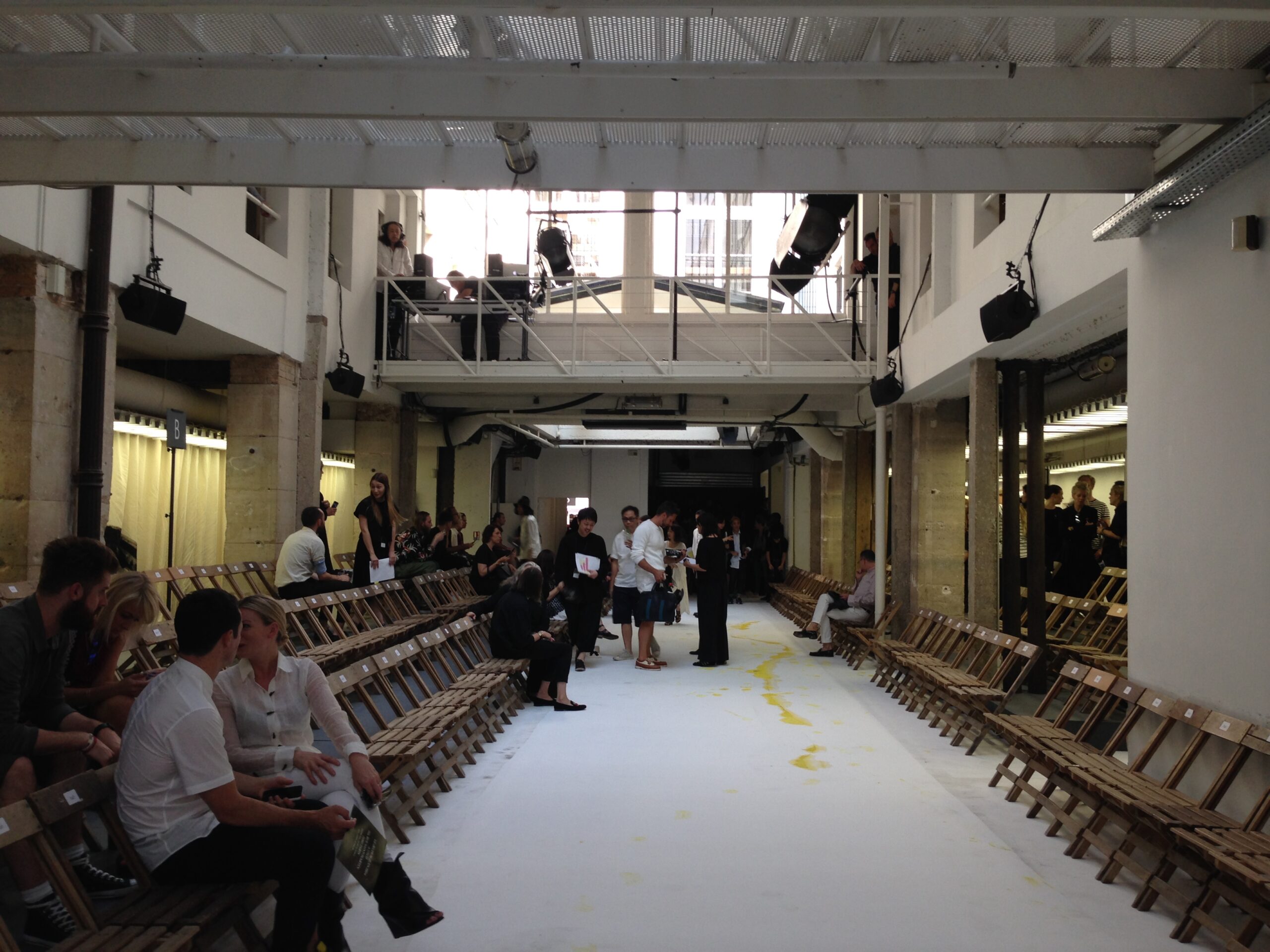
- In 2014, I actually saw the collection in Paris.
- What you should look at in a photograph is not just the clothes themselves.
- Why did Yohji Yamamoto use "Tokyo Story" for his invitations?
- What you can learn from the clothes you have on hand
- Two words to remember when looking at Yohji Yamamoto's clothes
Why do Yohji Yamamoto's clothes work despite being "oversized"?
When you look at Yohji Yamamoto's (honorifics omitted below) clothes, the first thing that catches your eye is the large space left between the body and the clothing. The shoulders are broad, the body is roomy, and the trousers have ample volume. However, they don't simply look like "big clothes."
The design incorporates everything from the way the fabric drapes due to its weight, to its sway when you walk, and even the silhouette it creates away from your body.
When I previously compiled a summary of the history of clothing, I noted down two characteristics of Yohji Yamamoto's work.
"Volume and drape"
This time, I'd like to reconsider these two phrases while reading Yohji Yamamoto's book, "Making Clothes: Beyond Fashion."
From haute couture to ready-to-wear
Before discussing Yohji Yamamoto, it's necessary to briefly review how clothing changed in the 20th century.
In haute couture, clothing is essentially made to fit a specific customer's body. The body is measured, the fabric is cut to flatter that body, and the three-dimensional structure is constructed accordingly.
On the other hand, prêt-à-porter is ready-to-wear clothing. It comes in standardized sizes such as S, M, and L, and an individual's body is expected to adapt to the garment's specifications.
There is a big difference here.
Do you adjust your clothes to fit your body?
Are we creating a different relationship between clothes and the body?
Japanese designers who gained attention in Paris in the 1980s greatly expanded this latter trend.
Things introduced by Japanese designers in the 1980s
In the early 1980s, the work of Japanese designers such as Rei Kawakubo, Yohji Yamamoto, and Issey Miyake presented a different view of the body from the Western fashion that preceded it.
The characteristics I organized in my notes on the history of clothing were:
Achromatic
Oversized
Asymmetry
Japanese materials
is.
Of course, the three designers' approach to clothing is not the same. Rei Kawakubo's work is about creating forms that transcend existing categories of clothing. Issey Miyake's work is about the space created between two and three dimensions, and his approach to clothing as a product.
And as for Yohji Yamamoto,
Volume and drape
I organized it using that phrase.
Yohji Yamamoto's oversized designs are not simply about making things bigger. They use a lot of fabric, and as that fabric drapes due to gravity, it creates a silhouette that is different from the body's contours. As a result, the impression changes considerably when the garment is hanging on a hanger compared to when someone is wearing it and walking around.
Not just the clothes themselves,Clothing requires an examination of the relationship between the body, fabric, gravity, and movement.is.
Why don't you emphasize your body?
In the history of Western fashion, there has been a long history of repeated attempts to shape the body through clothing.
In women's clothing, corsets and crinolines were used, and in men's clothing, tailoring was employed to create the ideal body shape. Clothing has a long history of shaping the body. Even in the latter half of the 20th century, body-hugging cuts and techniques that enhance the physique remained crucial elements of fashion.
In that context, Yohji Yamamoto's clothing looks a little different. Instead of exposing the body, it covers it. Instead of showing the body's contours directly, it wraps them in fabric.
That's where "a sense of volume" becomes important.
The jacket's width, long length, wide trousers, and overlapping fabrics—instead of showing the body itself, the silhouette created by the clothing is on full display.
And then, a sense of "drape" is added to it.
The soft fabric drapes over the shoulders and changes shape with the body's movements, creating a look that differs from that of a static, sculptural garment.
Fashion as discussed in "Making Clothes"
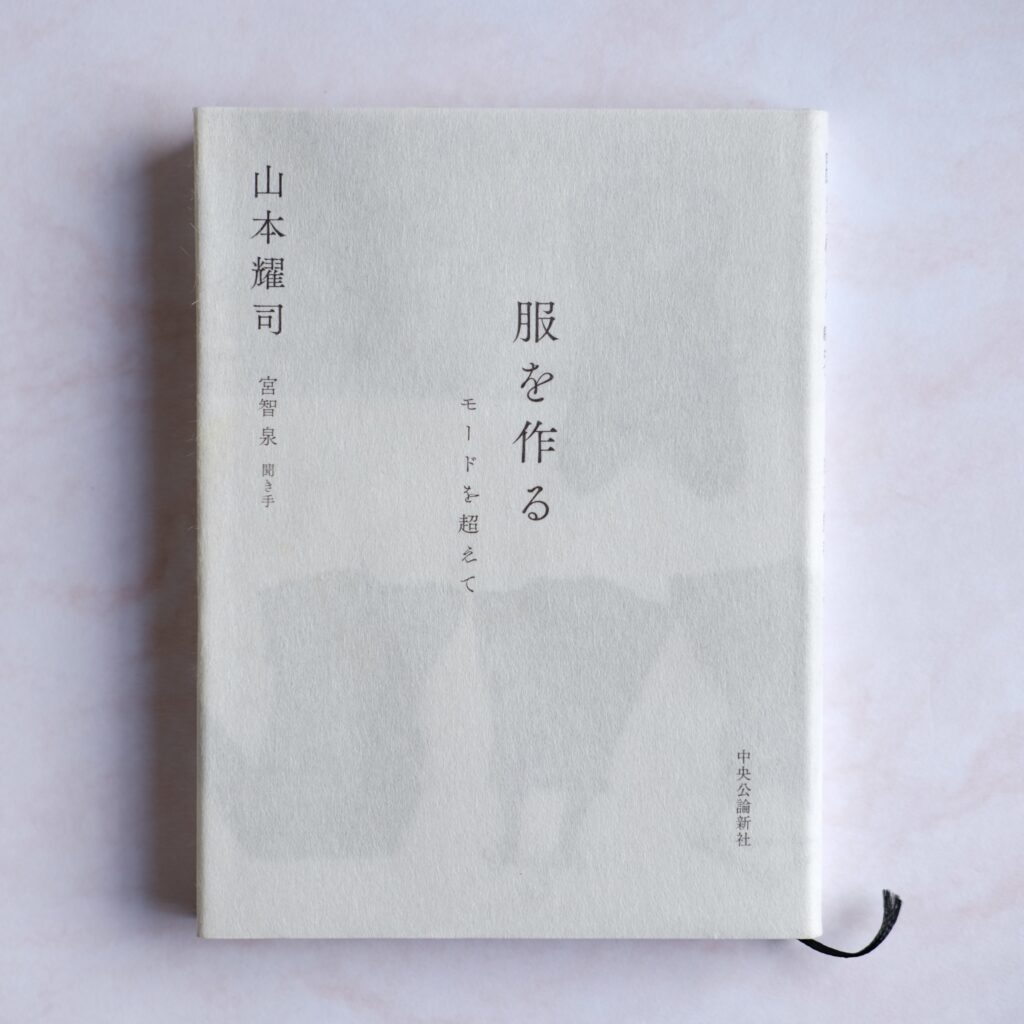
"Making Clothes: Beyond Fashion" is a book that chronicles Yohji Yamamoto's life from his upbringing to around 2013, primarily through his own testimony. It offers insights into the mindset of a clothing designer that cannot be gleaned from collection photographs alone.
In this book, Yohji Yamamoto views fashion not merely as clothing, but as an expression that gives form to things that cannot be put into words. When you look at his collections with this perspective in mind, you realize that there is no need to focus solely on the eccentricity of the clothes.
For example, if it's a large jacket,
"Why is it so big?"
Instead,
"How far away is it from your body?"
If you're wearing black clothes,
"Why black?"
Not only that,
"By toning down the colors, how do the volume and shape of the fabric appear?"
Let's take a look.
Adopting this perspective allows us to glean more information from collection photographs.
In 2014, I actually saw the collection in Paris.
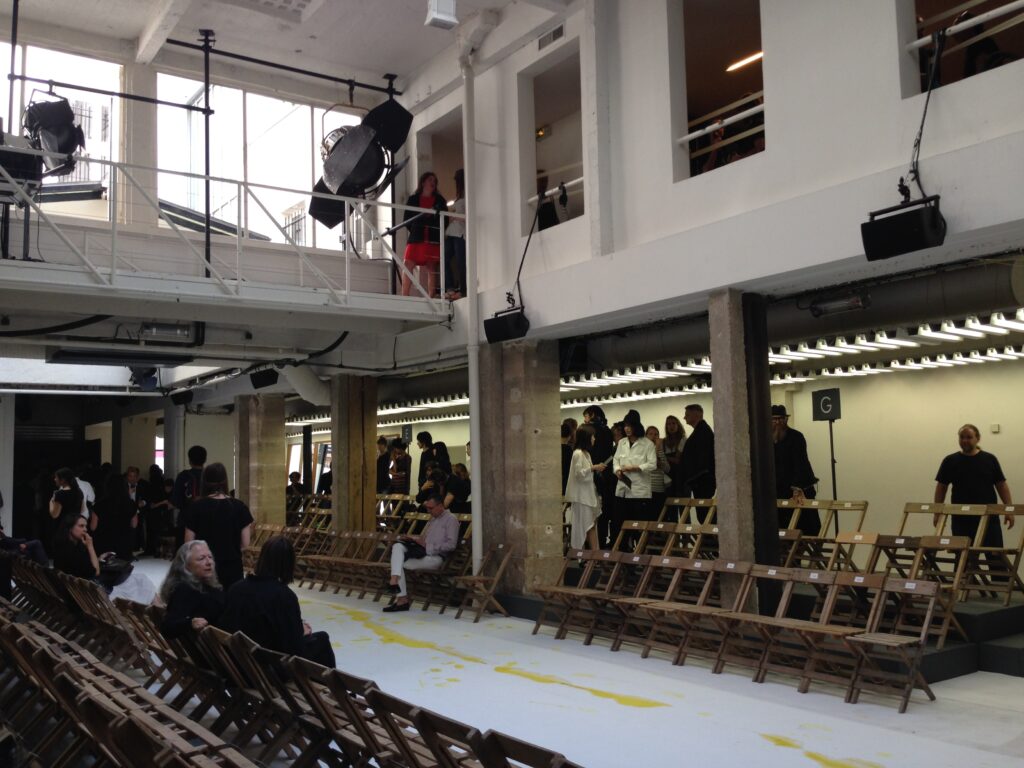
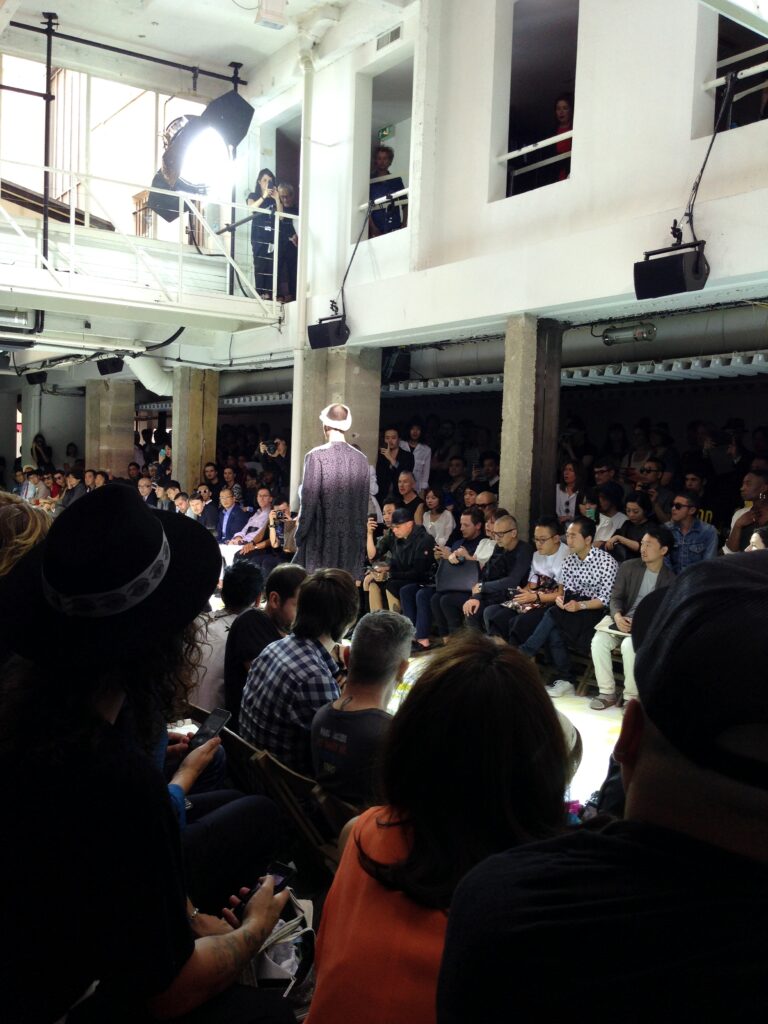
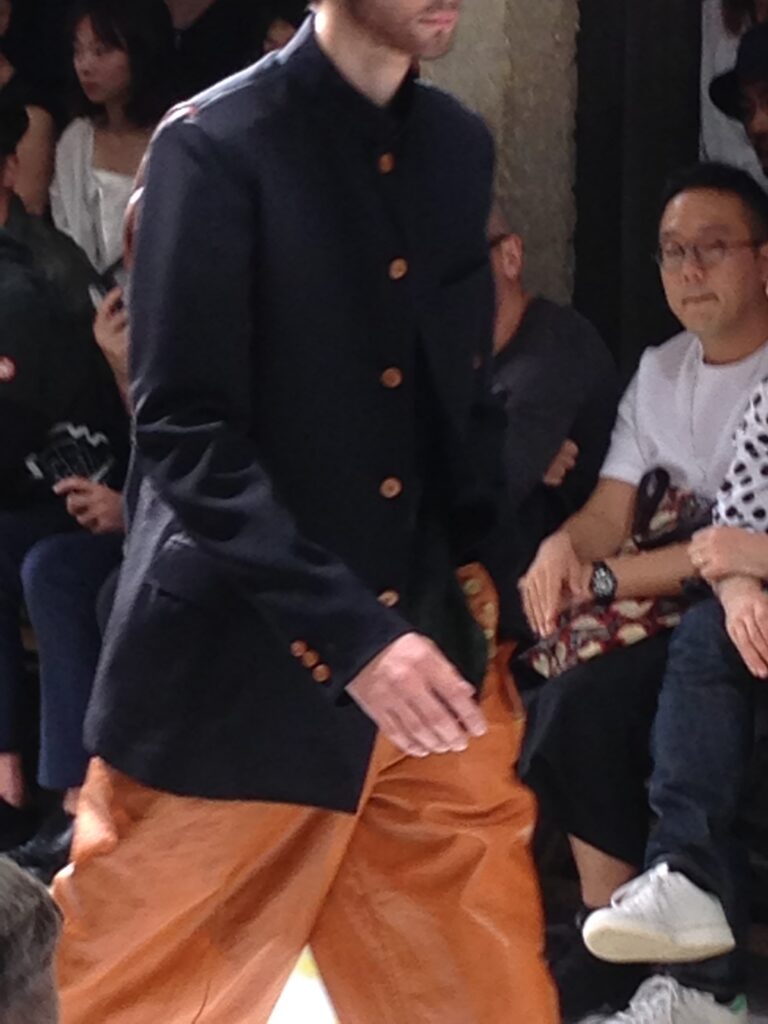
On June 26, 2014, I had the opportunity to see Yohji Yamamoto's men's collection in Paris.
This time, I looked back at the photos I took back then. I realized that the concept of "volume and fall" presented in this book is not fixed as a single style.
Jacket, long shirt, wide-leg pants, scarf, hat, layering.
At first glance, the items may seem different, but they all share the common approach of not making close contact with the body and instead creating a space of fabric around them.
This is especially clear when you look at jackets. In a typical tailored jacket, the shoulders, chest, and waist are used to define the body's contours.
On the other hand, in this collection, while the body is contained within the jackets, the body lines are not necessarily emphasized. The trousers also have ample volume. Because the fabric moves with every step, it is impossible to fully grasp the shape of the garments from a single frontal shot. This was something that became clearer when I saw the actual show.
On the runway, clothes are constantly in motion.
What you should look at in a photograph is not just the clothes themselves.
Show photographs are not only a record of the finished looks, but also a record of the environment in which the clothes were presented: the size of the venue, the distance to the audience, the lighting, and the speed at which the models walked.
A fashion show is not just a place to display clothes; it's a presentation that includes everything from where the clothes are shown, at what speed, and within what kind of space.
Nowadays, it's easy to view lookbook images online, but when looking at runway photos, instead of just looking at the clothes in isolation,
Model's movement, space, distance from the audience
If you look at it in detail, I think you'll be able to understand the collection more deeply.
Why did Yohji Yamamoto use "Tokyo Story" for his invitations?
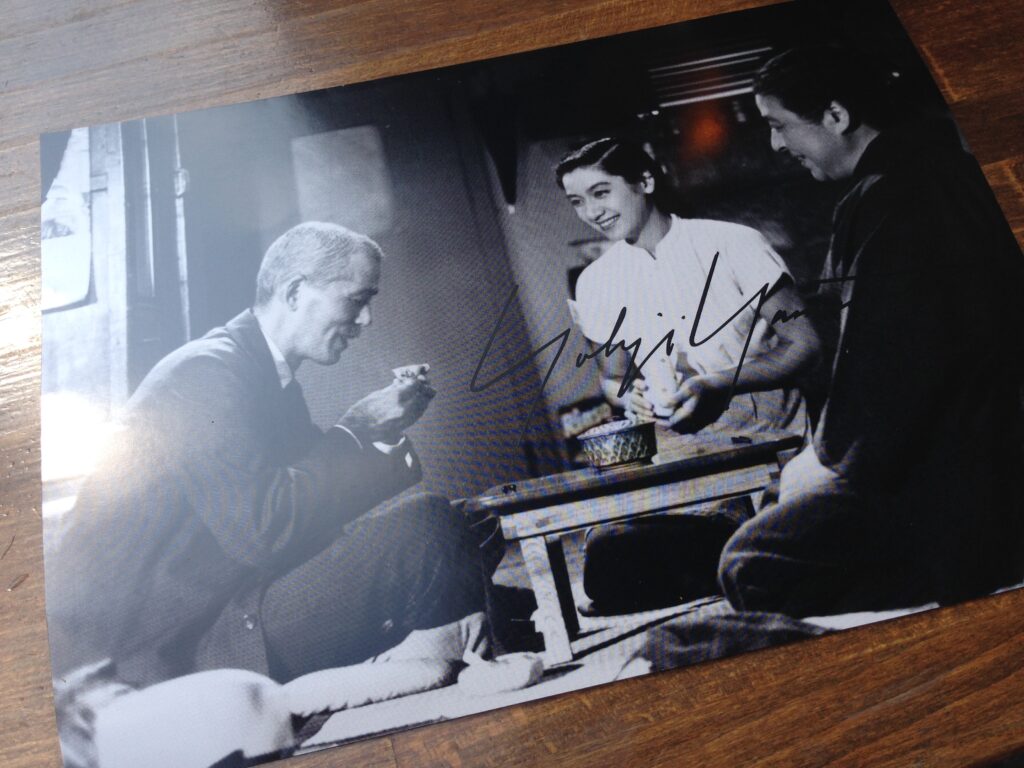
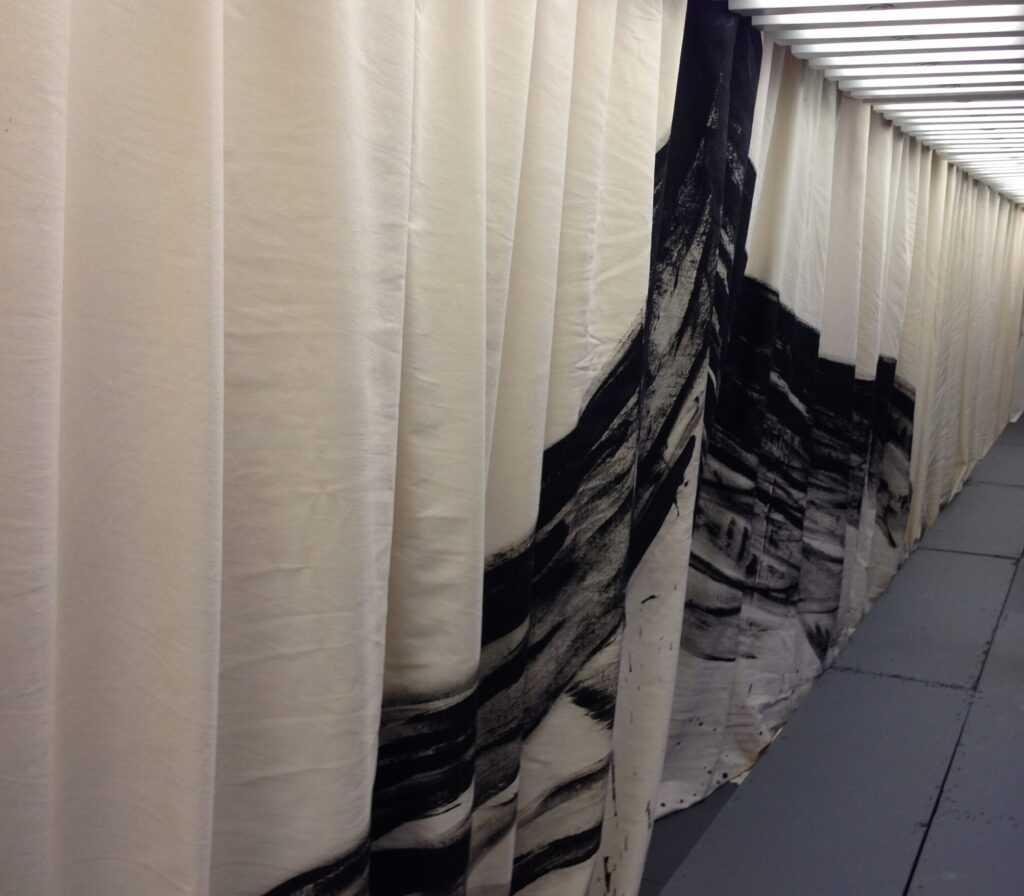
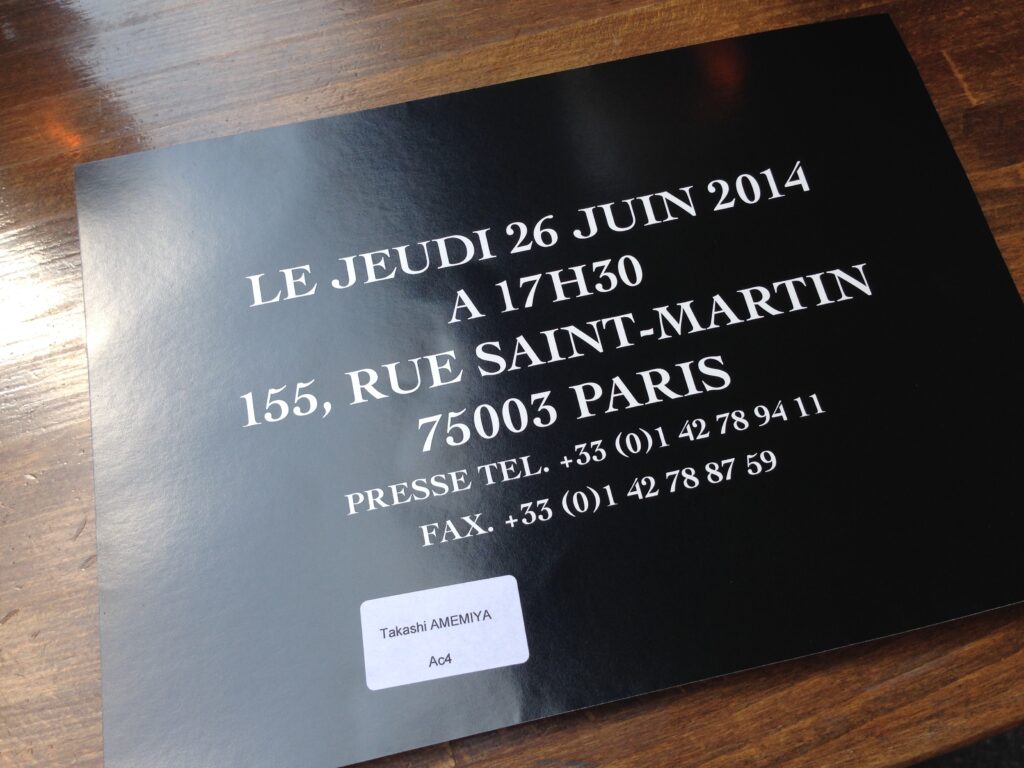
The front of the invitation features a still photograph from Yasujiro Ozu's film "Tokyo Story" (1953).
At the time, I was so engrossed in watching the show itself, but now, looking at this invitation alongside my collection, I'm quite curious about the meaning behind the selection of "Tokyo Story."
"Tokyo Story" is a story about an elderly couple living in Onomichi who visit their children who live in Tokyo.
However, the children living in Tokyo are busy with work and daily life and cannot spend quality time with their parents. More than their own children, Noriko, the wife of their second son who died in the war, cares deeply for the elderly couple.
What Ozu is depicting here is not a story about "unfilial children." In postwar Japan, as people migrated from rural areas to cities, a work-centered lifestyle was formed, and the structure of the family gradually changed. In the midst of this, even though no one is clearly at fault, distance is created between people.
Ozu himself left a commentary on "Tokyo Story," explaining that it depicted the breakdown of the Japanese family system through the growth of parents and children.
In other words, what is lost in "Tokyo Story" is not "an individual." It is the form of family, the sharing of time, intergenerational relationships, and the very structure of life that was previously taken for granted.
If you use this film as a starting point, the motif of "things that are lost," which repeatedly appears in Yohji Yamamoto's Spring/Summer 2015 men's collection, will take on a slightly different meaning.
"PERDU" - Clothing for searching for what has been lost
Towards the end of this season, graphics reminiscent of lost pet posters found on street corners appear. They feature photos of cats and dogs accompanied by messages like "MISSING CAT," and even include a photo of Yohji Yamamoto himself.
The words written there were,
"PERDU"
is.
It's a French word meaning "lost" or "missing."
Vogue's review at the time also noted that the show ended with looks representing "the lost cat," "the lost dog," and ultimately "the lost Yohji." It's clear that this was a performance that symbolized the sense of "loss" that permeated the entire collection, while also containing humor about Yohji Yamamoto himself.
A film about the quiet erosion of family structures, and clothing that searches for lost cats, dogs, and Yohji himself.
Not "broken clothes," but "clothes that have stood the test of time."
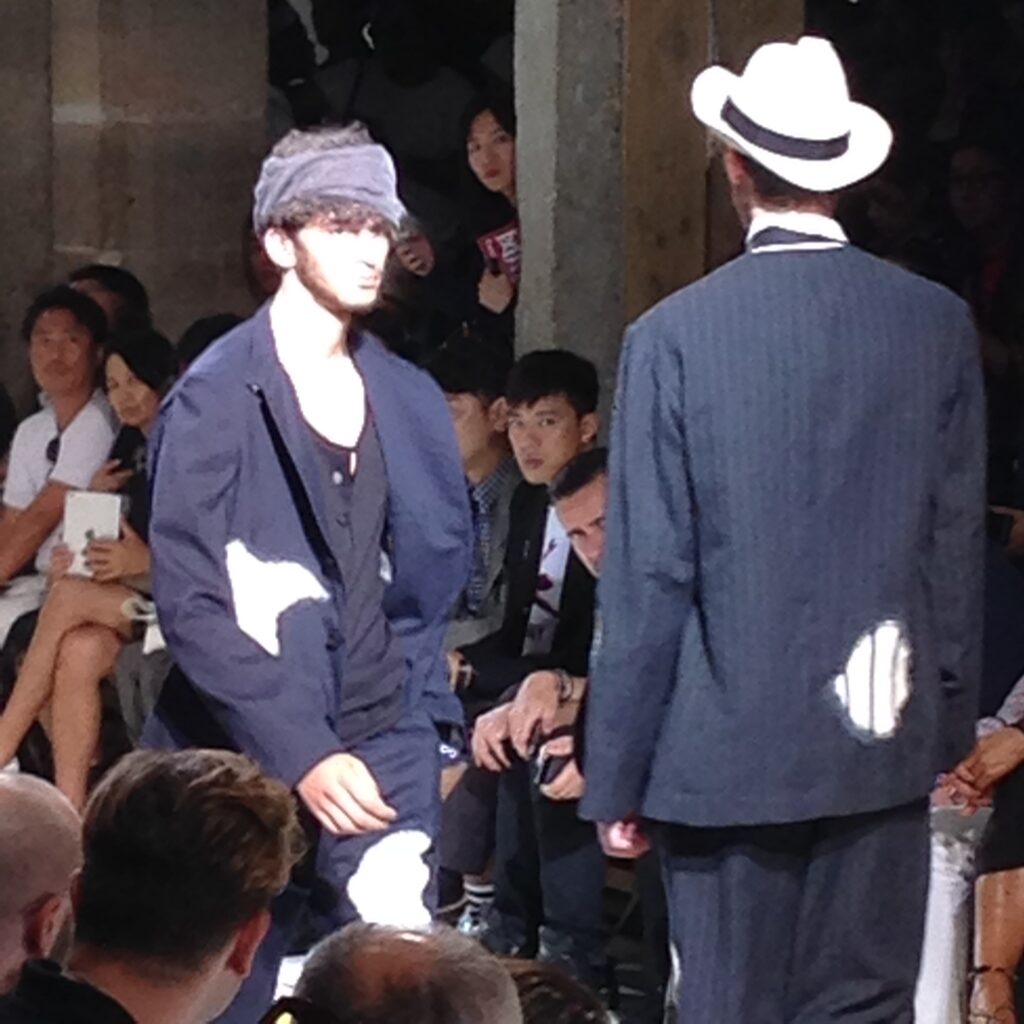
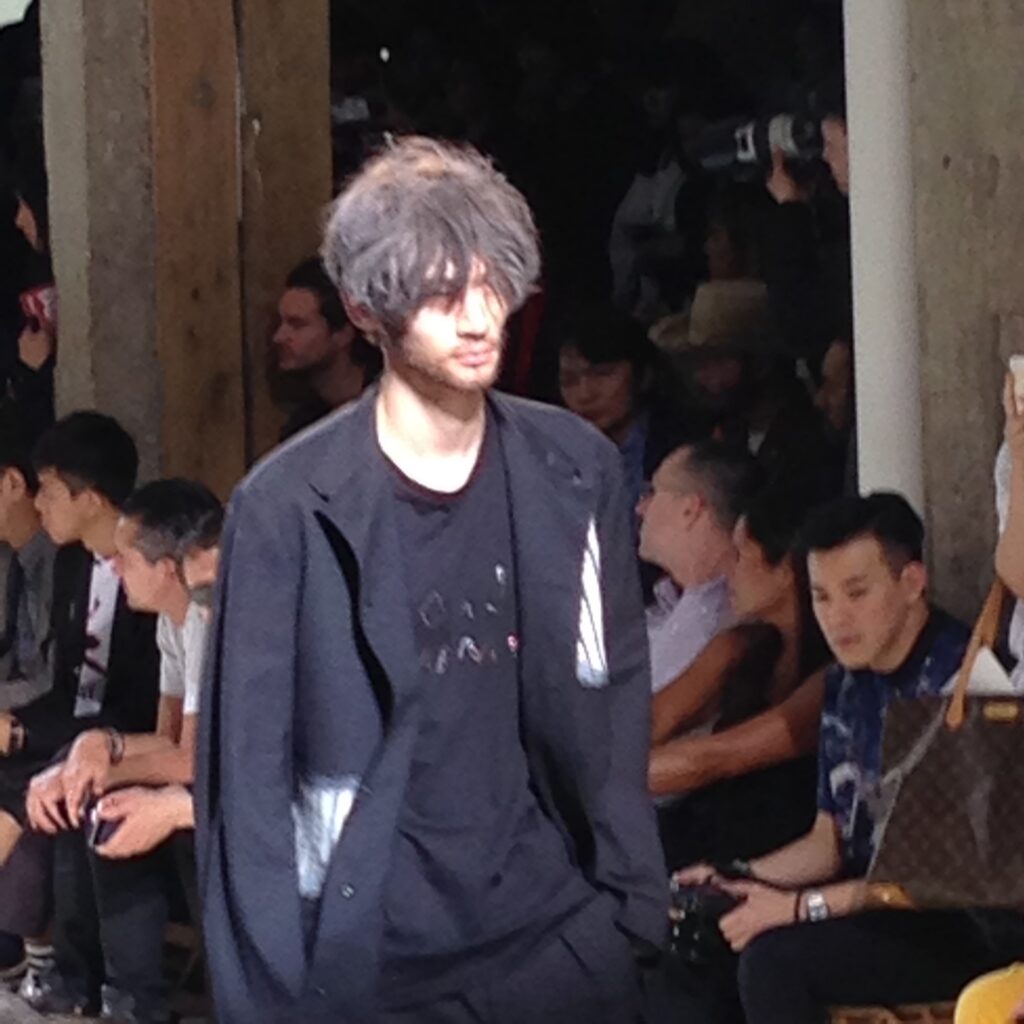
Looking at the Spring/Summer 2015 looks again, it's clear that the collection wasn't composed solely of well-fitting suits.
The collection features a mix of elements: appliqués that look like pinstripe fabric cut out and sewn onto another jacket, jackets with partially alternating panels, numerous buttons, fabrics with a worn look, denim, bandanas, and wide-leg pants. The fragmented construction of the jackets, the patches, and the double denim appear to be an extension of the deconstruction that Yohji Yamamoto has long explored.
At first glance, it looks grunge.
However, what's important is not the superficial style of being "dirty" or "torn,"It's about taking something that's already complete and then rebuilding it into a different relationship.Wouldn't you agree?
For example, a tailored jacket is supposed to have a symmetrical design, with the collar, sleeves, and pockets arranged in a certain order. If you cut and insert another material to close it up, the garment ceases to be a simple jacket.
Questions arise such as, "What did it look like before?", "Why is this part made of a different material?", and "What was repaired?". It's brand new, yet it seems to have a past.
From this perspective, the film "Tokyo Story" and its themes begin to align. Ozu didn't express "loss" by depicting a major event, but rather by portraying the everyday life of a family. Yet, something within that life is different from before.
There's a similar structure to Yohji Yamamoto's clothing. A jacket remains a jacket. Shirts, pants, and suits haven't disappeared in terms of their form. However, upon closer inspection, they're slightly out of their original order. I think the interesting thing about this collection is how it evokes a sense of time and memory in that "deviation."
What did "MADE IN JAPAN NO.1" mean?
And there's one more important word for this season.
"MADE IN JAPAN NO.1"
is.
Fashion Press connects this phrase with "Tokyo Story" and "PERDU," interpreting this collection as an awareness of the disappearance of Japanese craftsmanship.
This is a point we should observe without making any definitive statements, but it is important to note that at the very least, the two words "PERDU" and "MADE IN JAPAN" are placed within the same collection.
For many years, Yohji Yamamoto has presented his clothing on the international fashion stage of Paris, utilizing Japanese sewing techniques, materials, fabrics, and the skills of Japanese craftsmen.
Since the 1981 Paris Collection, Yohji Yamamoto's work has not simply been about "introducing Japanese things to the world." It is also a history of re-examining Western concepts of tailoring, how to present the body, beauty, and perfection through clothing made in Japan.
That's why "MADE IN JAPAN" means more than just a quality label indicating the country of origin. The technology and value may not last forever. Because there's a possibility of it being lost, we deliberately leave it as words on the clothing.
When interpreted in this way, "PERDU" and "MADE IN JAPAN NO.1" are no longer unrelated motifs.
Reflecting on "making clothes" from "Tokyo Story"
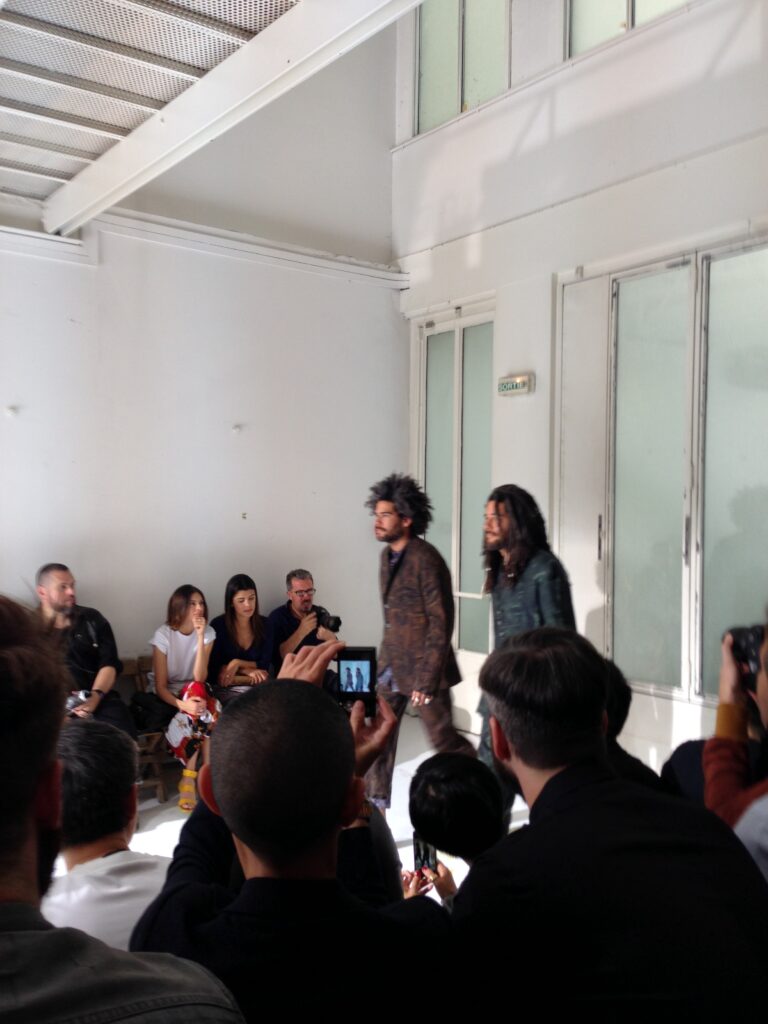
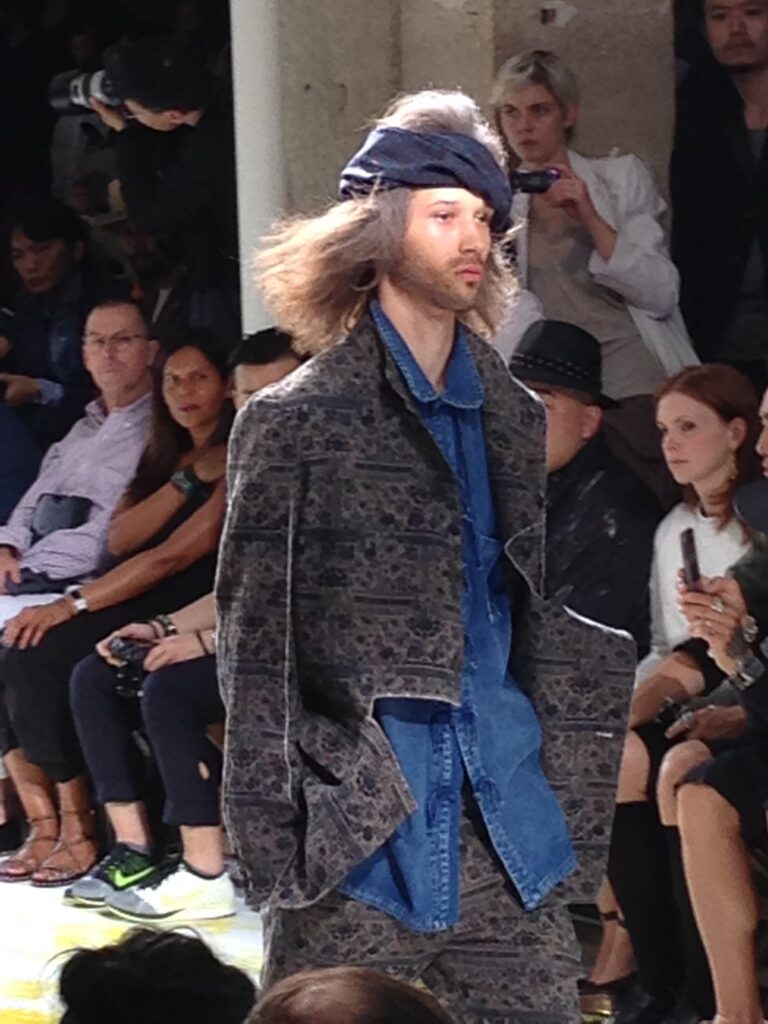
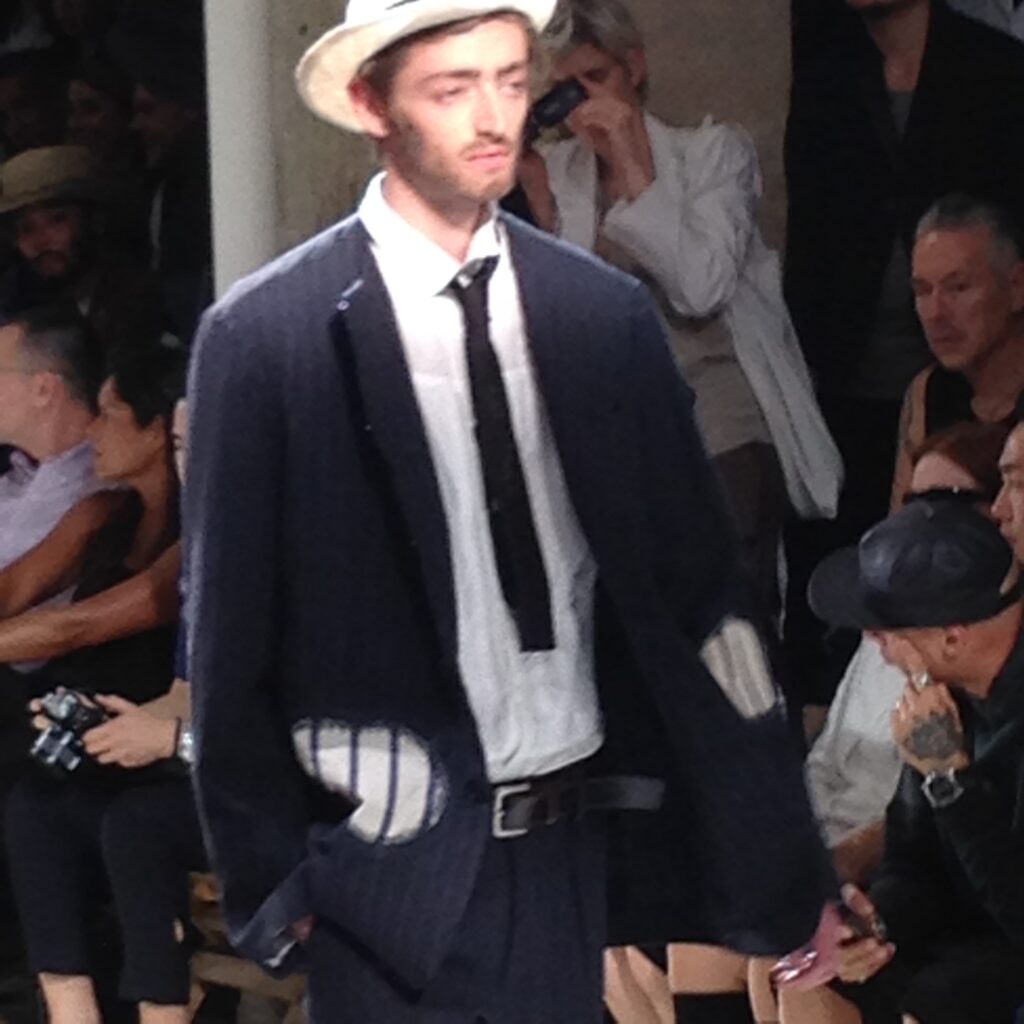
In his book "Making Clothes: Beyond Mode," Yohji Yamamoto describes fashion as an expression that gives form to things that cannot be expressed through words alone.
Looking at the Spring/Summer 2015 collection helps to clarify the meaning.
"Families change over time."
"People go through breakups."
"Technology will be lost."
"Even I myself will one day disappear."
If you're just printing this kind of information as an explanation on clothing, it doesn't need to be fashionable.
However, Yohji Yamamoto presents it as a single experience that encompasses silhouette, fabric, holes, patchwork, photography, lettering, styling, music, models, and even space.
Therefore, fashion shows are not simply "product launch events for the next season." At least when you look at Yohji Yamamoto's work,You can use clothing to construct a way of thinking.You can see that.
Even what I saw at that venue in 2014 was something I only understood at the time as clothes walking in front of me.
However, after more than 10 years, rereading the book and looking back at the invitation, and comparing "Tokyo Story" with the collection, I realized that behind each garment, multiple contexts overlap: film, postwar Japan, family, craftsmanship, and memory.
Perhaps this is where the fun of looking at fashion lies.
Instead of ending it with "Is it cool or not?",
Why this material?
なぜこの形なのか。
なぜこの言葉なのか。
なぜこの映画なのか。
そこまで遡っていくと、服は時代を読むための資料になります。
What you can learn from the clothes you have on hand


私はこのコレクションで発表されたジャケットとレザーパンツも所有しています。写真で見た服を実物で確認すると、ランウェイ写真だけでは分からなかった情報が出てきます。
例えばレザーパンツには複数のボタンが配置され、一般的な革パンツとは異なるディテールが使われています。ジャケットにもレザーが部分的に組み合わされています。
異素材をどこに置くのか、ボタンをどの位置に増やすのか、身体のどの部分に視線を集めるのか。服はこうした小さな選択の積み重ねでできているのではないでしょうか。
コレクション全体を見る。ランウェイで動いている状態を見る。最後に実物の縫製や素材を見る。
この三つを行き来すると、一着の服から得られる楽しみが増えてきます。
Two words to remember when looking at Yohji Yamamoto's clothes
ヨウジヤマモトについて調べると、「黒」「反モード」「オーバーサイズ」といった言葉がよく出てきます。もちろんそれらはファッション史的に重要です。
ただ、実際の服を見るときには、
Volume and drape
という二つの言葉を覚えておくといいかもしれません。
どれくらいの布を使っているのか。
身体からどれくらい離れているのか。
その布が重力によってどのように落ちているのか。
歩いたときにどこが動くのか。
『服を作る』と2014年のコレクション写真を並べて見直したことで、改めてそのことを確認できました。
comment