—Talking Heads, Rauschenberg, and the connection between film and movies
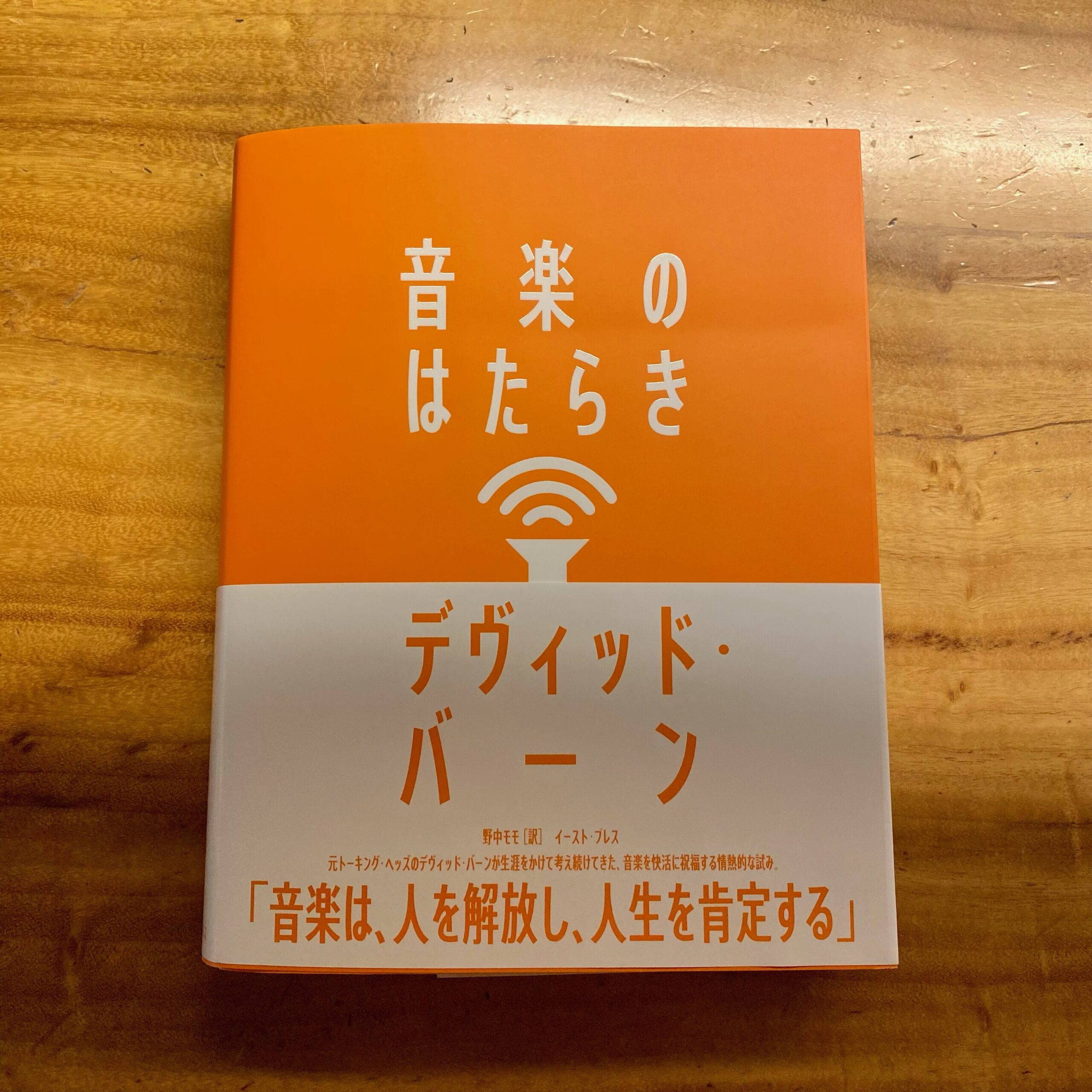
I read "The Function of Music" by David Byrne of Talking Heads, which had been sitting on my bookshelf unread.
I thought this was a book about music production, but it turned out to be much more interesting than I expected.
It's not just about "how to make a good song."
Where does music come from?
How will technology change creativity?
How do people discover music?
What exactly is originality?
How are works distributed, and how do they generate income?
And how is a "scene" formed where creative work is continuously produced?
As I continued reading, it began to feel less like a theory of music and more like a "system theory surrounding creativity" by an individual artist.
What I found interesting about this book was that reading it connected my previously separate interests in contemporary art, music, film, and design into a single cohesive whole.
- I didn't discover Talking Heads through their music.
- Creativity doesn't always originate from "inner self."
- Are "accurate work" and "good work" the same thing?
- In an age of unlimited information, the ability to "choose" becomes valuable.
- Following David Byrne will lead you to his films.
- "Stop Making Sense" is a film that visualizes "creation in reverse."
- Look at the "system that produces the works," not the works themselves.
- Draw a line between pieces of knowledge.
I didn't discover Talking Heads through their music.
My initial introduction to Talking Heads wasn't actually through their music.
It was Robert Rauschenberg.
Rauschenberg is one of the leading artists of 20th-century art, creating works that transcend existing categories such as painting, photography, printmaking, textiles, and everyday objects.
I learned over a decade ago that he had done the artwork for Talking Heads' album 'Speaking in Tongues'.
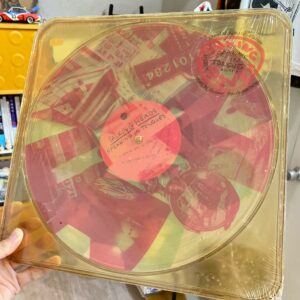
"What kind of band is Talking Heads, which Rauschenberg was involved with?"
From there, my interests expanded from contemporary art to music.
This limited edition of 'Speaking in Tongues' has a very different record jacket than typical ones.
The unique packaging, which uses transparent materials and layers multiple images, is itself a work of art.
Rauschenberg won a Grammy Award for Best Recording Package for this work.
I currently own this LP, but I still haven't been able to open the outer sleeve.
Come to think of it, it's already interesting at this point.
This is because the boundary between the act of "looking at works of art" and the act of "listening to music" has become blurred.
And this feeling strangely overlapped with David Byrne's own views on creation.
Creativity doesn't always originate from "inner self."
One of the ideas I found particularly interesting in "The Function of Music" was "creation in reverse."
When we think of creative work, we tend to imagine the following sequence:
The author's inner world
↓
the work
↓
Places to present your work
First, an artist has something they want to express, that becomes a work of art, and only after it's completed do they look for a place to present it.
I think this is a very familiar perspective on creative work.
However, Byrne also views the creative process from the opposite perspective.
Where will it be performed?
What kinds of technologies exist?
Who is listening?
What kind of society or culture are you in?
Perhaps that "environment" existed first, and music has evolved to adapt to it.
In other words,
environment
↓
constraints
↓
the work
This is the perspective from which we view creation.
For example, the type of music that sounds most effectively in a cathedral with a long reverberation time will naturally be different from the music that sounds most effectively in a small live music venue.
When the space changes, the music changes too.
When recording technology changes, music changes too.
When the audience changes, the music changes too.
Looking only at what's going on inside the creator's head won't fully explain why the work took the form it did.
I don't think this way of thinking is limited to music.
Are "accurate work" and "good work" the same thing?
"The Function of Music" also contains some interesting information about digital recording.
With current software, it's possible to correct performance discrepancies and tempo fluctuations with considerable precision.
By aligning the sound with the grid, you can create "accurate performances."
However, Byrne also considers what is lost in the process.
If we were to eliminate even the subtle fluctuations and discrepancies inherent in human performance, would it truly become good music?
From this, we can deduce that
Making things "correct" through technology is not the same as making things "better."
That's the problem.
Technology improves the level of perfection.
However, at the same time, it could also eliminate the inherent fluctuations that are characteristic of things created by humans.
Now that AI can assist with so many creative processes, I think this question has become even more important.
In an age of unlimited information, the ability to "choose" becomes valuable.
Personally, one of the chapters that made me think the most was "The Power of Curation."
In the past, listening to music involved a cost simply for accessing it.
I'm going to a record store.
I listen to the radio.
I read a music magazine.
I'll ask a knowledgeable friend for advice.
However, nowadays, you can instantly access a vast amount of music by simply opening Spotify or YouTube.
The same applies to movies.
The same goes for books.
Clothing and art are the same.
The problem then is,
"How do I get it?"
from,
"What will you choose from an infinite number of options?"
Move to [destination].
I think this is a pretty big change.
In times when information was scarce, simply "knowing something" became a valuable asset.
However, in this age where anything can be searched,
"This is interesting."
"This is worth seeing."
"These two things may seem unrelated at first glance, but they are actually connected."
The act of choosing something and giving it context itself becomes valuable.
Not only possessing a large amount of knowledge,
Draw a line between pieces of knowledge.
I think this is also a form of creation.
Following David Byrne will lead you to his films.
And as we continued to follow Byrne, the story then led us to the world of film.
Bernardo Bertolucci's "The Last Emperor" (1987).
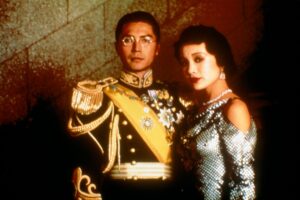
Many people would probably think of Ryuichi Sakamoto when they hear the music for this film.
However, Ryuichi Sakamoto was not the only one responsible for composing the music.
David Byrne and Su Cong also participated, and all three won Academy Awards for Best Original Score.
Talking Heads and "The Last Emperor".
Two cultures that seem quite far apart at first glance are connected through a man named David Byrne.
Furthermore, Byrne's play "American Utopia" was later adapted into a film by Spike Lee.
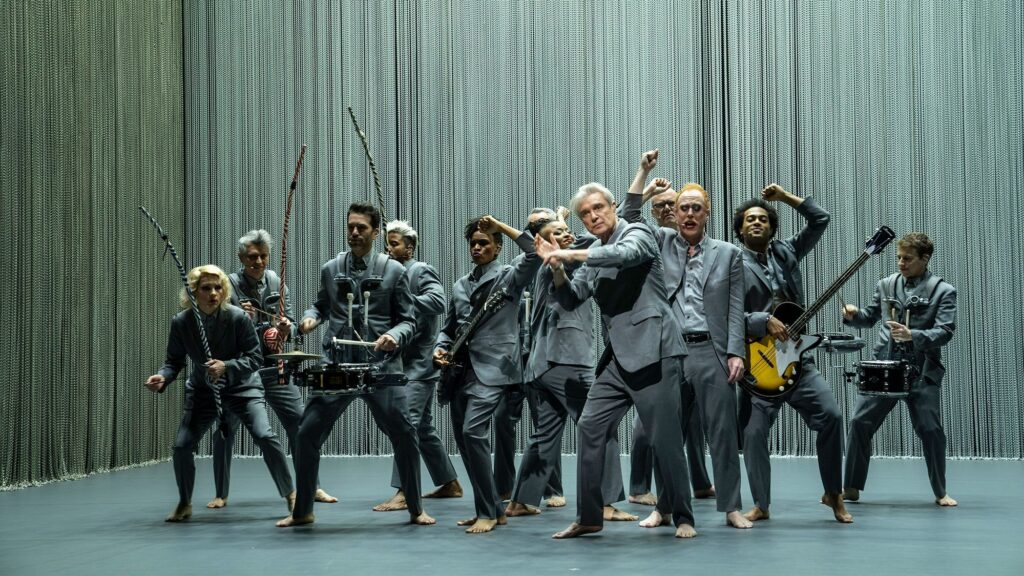
And Talking Heads itself has a concert film called "Stop Making Sense," directed by Jonathan Demme.
music.
contemporary art.
movie.
stage.
design.
As you follow Byrne's work, the very idea of classifying them as separate genres gradually loses its meaning.
"Stop Making Sense" is a film that visualizes "creation in reverse."
It's also interesting to watch "Stop Making Sense" in this context.
The film begins with David Byrne appearing alone on a nearly empty stage.
As the performance progresses, more members, instruments, and stage equipment are added, and the stage itself gradually comes to life.
In other words, the audience doesn't just see the finished show,The process by which the environment that allows music to exist is put together.You will see this.
The body, costumes, lighting, stage, and performance are inseparable, including the famously gigantic suits.
Rather than presenting music solely as "sound,"
How do humans appear, move, and sound within a given space?
It is designed as a single work, encompassing all of these elements.
After reading "The Function of Music," one realizes that David Byrne's theories on creative work and the actual works he has produced are quite similar.
Look at the "system that produces the works," not the works themselves.
What remained after finishing "The Function of Music" was not just knowledge about music.
When viewing a work of art,
"Who made this?"
but also
"Why did this work come into being in this era, in this place, with this technology, and with these human relationships?"
That's what I think.
Instead of just looking at the author, look at the system surrounding the author.
And when I create something,
"What do I want to express?"
Not only that,
"What kind of environment do I create in?"
"Who will experience it, where, and how?"
Let's think about it that far.
Then, the act of creation begins to look a little different from the image of a solitary genius retrieving something from their mind.
Draw a line between pieces of knowledge.
This time, I read a book.
But from there,
Rauschenberg.
Talking Heads.
sampling.
CBGB.
"The Last Emperor".
Ryuichi Sakamoto.
"Stop Making Sense."
Spike Lee.
If you look at each one as an independent genre, they are separate stories.
However, if you draw a line in between, the world suddenly becomes three-dimensional.
So lately, rather than just increasing my knowledge,
Drawing a line between pieces of knowledge
I find it interesting.
Creation isn't just about bringing something into existence from nothing.
Connecting things that were thought to be separate.
Move something that already exists to a different location.
Let's reconsider it from a different context.
Rauschenberg's collages,
Music sampling is also
David Byrne's genre-crossing activities are also
In that sense, they are connected in some way.
My own introduction to Talking Heads was through a single record cover.
Let's extend just one more line from one of the works.
Beyond that lies a world of movies, music, books, and art that you've never known before.
When you think about it that way, even a single record can connect you to a surprisingly wide world.

comment