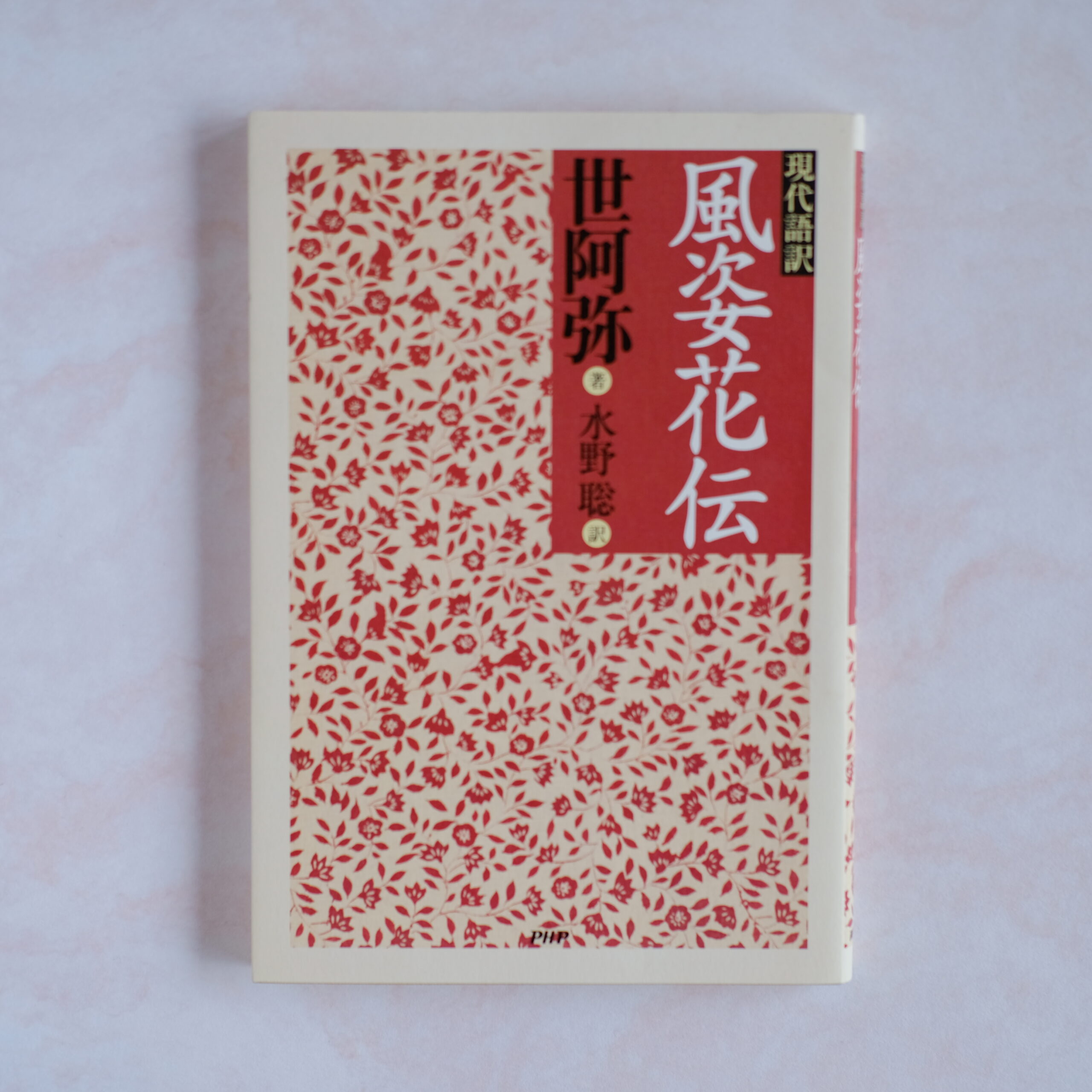
-A first-class theory of medieval culture-
point
The importance of deliberately keeping things secret
- Do what needs to be done without becoming complacent
Zeami (1363-1443) was a Noh performer of the early Muromachi period.
"Fūshikaden" is an art treatise written by Zeami, the great master of Noh theater, over a period of approximately 20 years. Composed of systematic theory and profound words, it is rare to find an art treatise written by an artist himself. Using "hana" (flower) and "yūgen" (subtle and profound beauty) as keywords, it delves into Noh training methods, principles, acting theory, directing theory, history, and aesthetics. I believe it is a useful philosophical work for anyone striving to master something, not just Noh.
It is said that one must first follow the path, and that good fortune and fame will follow as a result of mastering that path. If one aims to gain wealth or fame from the beginning, the path will decline. Also, sometimes one can gain fame simply because of their youth. However, this is not due to genuine ability but to their youth, so one should strive to master the path every day without becoming complacent. The importance of learning from both the skilled and the unskilled is also touched upon.
The article also examines Noh from the customer's perspective. What one found interesting yesterday might not be interesting today, and then later, it might be interesting again. The author argues that since reactions to Noh vary daily, it's important not to be discouraged, but rather to simply believe in performing a good Noh play. This principle applies to everything, doesn't it?
Towards the end, there is an oral tradition passed down from father to son, and there is a theory that if the successor does not possess the necessary skills, the tradition does not need to be passed on. This reveals Zeami's seriousness and strictness towards Noh, and I am grateful that I can still hold the Fūshikaden in my hands, as it has not disappeared from this world.
Author: Zeami Translator: Satoshi Mizuno Paperback: 111p Publisher: PHP
First reading completed on 2011/07/14
Finished reading it for the second time on 2021/06/14
Memo
Akiko Baba, author of "Studies on Demons," mentions Zeami's Fūshikaden in the following YouTube video.
Akiko Baba's lecture "Shura Noh and Song" - What Zeami meant by "Shura Noh" (2018 / From the special lecture "Discussing the World of Shura Noh")
① https://youtu.be/RWM1x-3ktmE
② https://youtu.be/-_y1V6zjJJ4
Shuranō refers to Noh plays in which a warrior is the shite (main character). It is also called Shuramono. This type of Noh was established by Zeami and is mentioned in Fūshikaden. However, the text contains contradictory expressions, which Mr. Baba explains in the video.
Zeami lived during a time of social upheaval, power struggles between the emperor and the shogunate, and intense local greed. He expressed the gap between the greedy samurai and his ideal image of a samurai through his Shura Noh plays.
A cultural scent that even samurai should possess. A culture destroyed by war.
Akiko Baba explains the Noh play "Utou" and poetic place names ~Special performance "A Journey to Poetic Place Names with Akiko Baba"~
Part 1https://youtu.be/4uCimSeY0XA
Part 2https://youtu.be/XiAHMNwMJ_M
This discussion uses the Noh play "Utou" as its subject matter to examine the function of utamakura (poetic place names). (A makura is a familiar word or a word with two or more meanings used as a placeholder.) Zeami apparently said that to write Noh, one only needs to study poetry, and that studying utamakura adds dignity and depth to Noh. It made me realize once again that people who can skillfully use words have been successful, both in the past and present.
Synopsis
This is the story of a hunter who made a living by killing rhinoceros auklets, but after his death, he becomes a ghost, regretting his killing in life and lamenting the sadness of having no other way to survive. It is a sorrowful and intense work that depicts the sorrow of life and the suffering of hell.
Thank you for reading. Goodbye for now. Take care :)
comment